



 Idaho Steel Embraces 3D Printing to Deliver Supe…
 Monash University Revolutionizes Human Anatomy S…
- With the Help of Geomagic Wrap, There Is New Hop…
- Nationwide Children’s Hospital, Research Instit…
- 3D Scanning Museum Specimens with Teens at Carne…
- 3D Scanning and Printing Bring Artwork to Life
- Planetary Resources Uses 3D Printed Casting Patt…
- Thales Alenia Space and 3D Systems Prove Viabili…
- ZetrOZ Reduces Product Time-To-Market With MJP M…
- Realistic FEVAR Hands-On Training Made Possible …
- Innovative Metal 3D Printing for the Operating R…
- Conzept Solutions Replaces a Hard to Find Part U…
- The Smallest Soccer Player in the World Repaired…
- Delivering the Gift of a Normal Life with 3D Sys…
- 3D Printing Streamlines Prototyping for Smartpho…

2F | Software
-
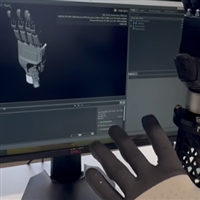 Dexterous manipulation research relies on demonstration data collected through teleoperation.
[More]
-
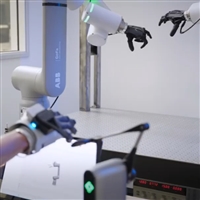 The recent collaboration between ABB Robotics and PSYONIC demonstrates how human-generated data is helping advance robot learning. As part of this workflow, MANUS gloves were used to capture natural hand movements that contribute to human demonstration data for robot training. Haply,as another part of the workflow, supports the wrist tracking and…
[More]
-
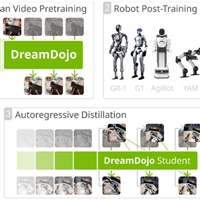 Robot world models predict how the world changes in response to actions, supporting applications like teleoperation, policy evaluation, and model-based planning. For dexterous robotics, this is complicated by limited robot data and scarce action labels, since collecting robot trajectories is costly and hardware variation restricts scenario covera…
[More]
-
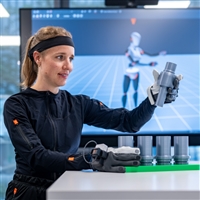 BMW Group Plant Landshut is expanding its work in physical AI, taking on central software development for AI-supported robotics in component production. The plant's demonstration-based learning workflow uses MANUS data gloves to capture the dexterous manipulation data that trains its humanoid robotic systems.
[More]
-
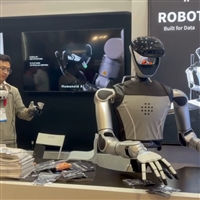 ROBOTERA XHAND 1 Pro combines 21 active degrees of freedom with a fully actuated architecture and tactile sensing distributed across the entire hand surface. This combination of joint-level control and dense contact sensing supports complex grasping, in-hand manipulation, and reinforcement learning research. These applications require both precis…
[More]
-
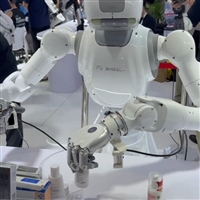 BrainCo Revo 3 is a five-finger dexterous hand developed for humanoid robots, embodied AI research, teleoperation, and manipulation. Its 21 independently actuated degrees of freedom support a wide range of finger movements and grasp configurations. Controlling this level of articulation requires more than detecting whether the operator's hand …
[More]
3F | Solution
-
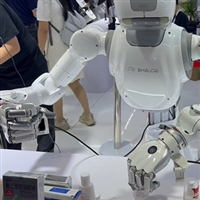 BrainCo Revo 3 is a five-finger dexterous hand developed for humanoid robots, embodied AI research, teleoperation, and manipulation. Its 21 independently actuated degrees of freedom support a wide range of finger movements and grasp configurations.
[More]
-
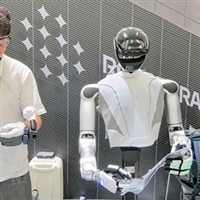 ROBOTERA XHAND 1 Pro combines 21 active degrees of freedom with a fully actuated architecture and tactile sensing distributed across the entire hand surface. This combination of joint-level control and dense contact sensing supports complex grasping, in-hand manipulation, and reinforcement learning research. These applications require both precis…
[More]
-
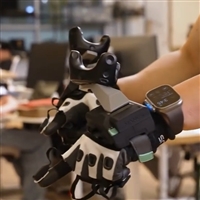 Artly AI is a US-based technology company developing embodied AI systems that replicate human-level dexterity for the service industry. The company's Barista Bot doesn't simply dispense coffee, it executes the complex, fluid motions of an expert barista, from precisely controlled pours to the subtle wrist movements required for latte art.
[More]
-
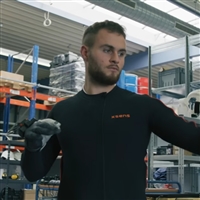 Unlike large language models that can draw on billions of web pages for training, humanoid robots require high-quality, real-world physical interaction data. This data simply does not exist at scale on the internet, and simulation alone cannot replicate the complexity of real-world physics.
[More]
-
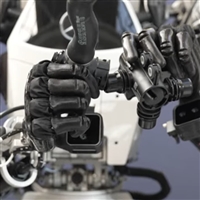 Deploying humanoid robots in unstructured, real-world manufacturing environments is one of the hardest unsolved problems in robotics. An effective path to that capability is teleoperation-driven imitation learning: capturing high-fidelity human motion data and using it to train robot policies that generalize across tasks and conditions.
[More]
-
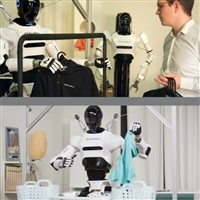 A world leading robotics company has introduced an advanced physical AI training facility designed to bridge the gap between AI models trained in simulation and their performance in real-world environments.
[More]
-
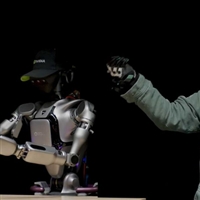 Dexterous robot hands are becoming a cornerstone of embodied AI. Recent advances in motion capture, simulation, reinforcement learning, and self-supervised foundation models have enabled robots to perform increasingly human-like manipulation skills.
[More]
-
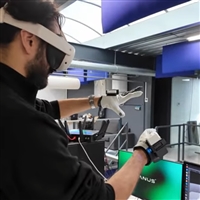 MANUS gloves have been officially integrated into NVIDIA's Isaac Lab 2.3 as a native teleoperation device, enabling researchers and robotics teams to use MANUS gloves to teleoperate simulated robots inside NVIDIA's Isaac Lab environment, capturing high-fidelity demonstration data for robot policy training at scale.
[More]
-
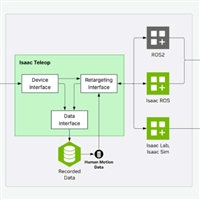 At NVIDIA GTC this year, NVIDIA brought Isaac Teleop to General Availability. Isaac Teleop is a unified framework for teleoperation and data collection across simulation and real-world systems, standardizing how human input is translated into robot actions.
[More]
-
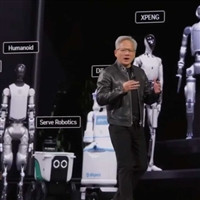 NVIDIA GTC 2026 was one of the biggest robotics moments of the year, and MANUS was proud to be part of it. From Jensen Huang's opening keynote to a live session on the GTC stage, from an exclusive hands-on demo space to deep integrations with NVIDIA's latest robotics stack, GTC 2026 validated what we've been building toward: precision hand tracki…
[More]
-
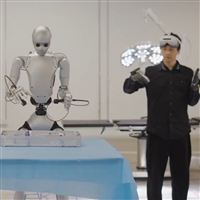 NVIDIA Unveils Isaac GR00T Reference Humanoid Robot at GTC Taipei With MANUS Gloves in the EcosystemAt GTC Taipei 2026, NVIDIA announced Isaac GR00T Reference Humanoid Robot, the first open humanoid reference design built on NVIDIA Jetson Thor and the Isaac GR00T platform. The reference design pairs a Unitree H2 humanoid robot with dual Sharpa Wave five-finger hands, NVIDIA Jetson Thor onboard compute, and the Isaac GR00T software stack.
[More]
-
 Dexterous robotic hands have made significant progress in 2026, with advances in dexterity, tactile sensing, and real-world stability across a range of hardware platforms. As hardware matures, the field is turning its attention to a harder challenge, generating the large-scale, high-quality data needed to train dexterous manipulation systems.
[More]
more>>